Valid Parentheses: Matching Brackets with a Stack
Learn why bracket order needs a stack, trace a linear-time solution, and implement Valid Parentheses in C#, Go, and Python 3.
- Stacks
- Strings

Problem
Determine whether a string s forms valid pairs of brackets. The string contains only (, ), {, }, [ and ]. Return true when all of these rules hold, or false otherwise:
- Each opening bracket is paired with a closing bracket of its own type.
- Pairs nest correctly: an inner pair finishes before the pair around it.
- No closing bracket appears without a matching opening bracket.
Example 1
Input: s = "()"
Output: true
Example 2
Input: s = "()[]{}"
Output: true
Example 3
Input: s = "(]"
Output: false
Example 4
Input: s = "([])"
Output: true
Example 5
Input: s = "([)]"
Output: false
Constraints
1 <= s.length <= 10^4- Every character in
sis one of the six bracket characters above.
By the end of this lesson, you should be able to explain why counting brackets is insufficient, choose a stack, and write a solution that scans the string once.
Why counting is not enough
An equal number of opening and closing brackets is necessary, but it does not prove that the string is valid. For example, ")(" has one of each, but its first character closes a pair that never opened.
Even separate counts for each bracket type lose information. In "[(])", the totals balance and no type closes before its own opener, yet ] arrives while ( is still waiting to close. We need to remember the order of the unmatched openings.
One alternative is to repeatedly remove adjacent matching pairs: (), [], and {}. A valid string eventually becomes empty. However, deeply nested input such as "((()))" can require a new scan for each nesting level. With full-string scans and copies, this approach can take O(n²) time.
We can keep track of the nesting as we read instead.
The stack idea
A stack gives us three operations: push adds an item to the top, peek reads the top, and pop removes it. The most recently pushed item is the first one removed: last in, first out.
Key idea
The last bracket opened must be the first one closed. A stack preserves exactly that order; its top tells us which closing bracket must come next.
How to think about it is: whenever you see an opening bracket, put its opposite closing bracket into the stack. Otherwise, if you see a closing bracket, remove the top item from the stack.
Before removing it, check two things:
- If
stack.Count == 0, that means you have a closing bracket without a matching opening bracket, so returnfalse. - If
stack.Peek()is not the closing bracket you are currently looking at, that means the brackets do not match, so returnfalse.
At the end, the stack should be empty. If it is not empty, that means there are opening brackets that were never closed.
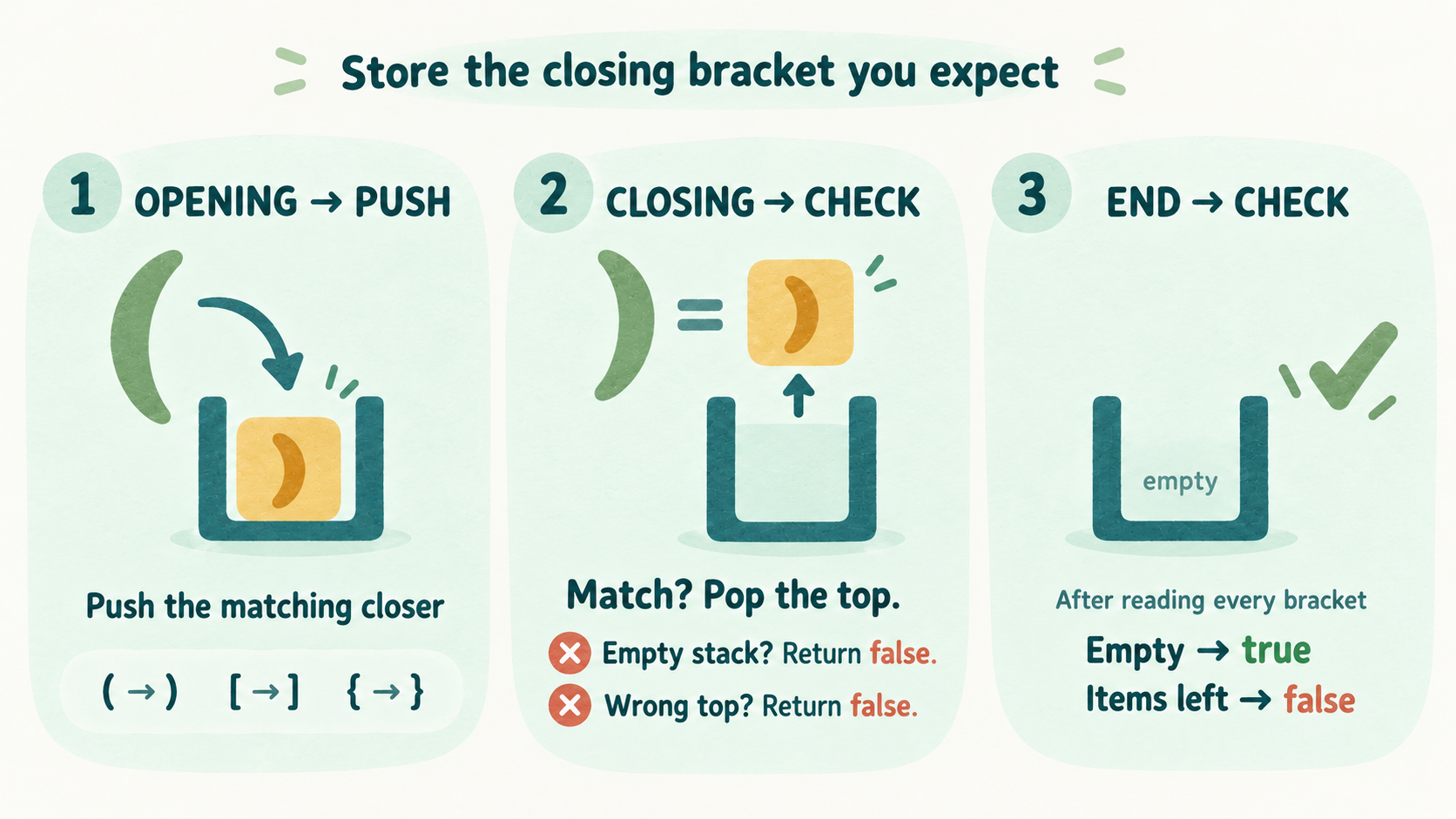
Store the closing bracket you expect, check it when a closer arrives, and finish with an empty stack.
We could store opening brackets and check their partners later. Here, we store the expected closing brackets instead:
| Opening bracket | Push onto the stack |
|---|---|
( |
) |
[ |
] |
{ |
} |
When a closing bracket arrives, it must equal the stack’s top. This lets us compare the characters directly.
Algorithm
- Start with an empty stack.
- For each opening bracket, push its matching closing bracket.
- For each closing bracket, return
falseif the stack is empty or its top is different. Otherwise, pop the matching top. - After reading the entire string, return whether the stack is empty.
The final check matters: reaching the end without a mismatch does not mean all openings were closed.
Walkthrough: a valid string
Trace "[({})]". The stack below runs from bottom to top, so the rightmost entry is the next closing bracket we expect. The word “empty” means there are no entries.
| Index | Character | Action | Stack after the action |
|---|---|---|---|
| 0 | [ |
Push ]. |
] |
| 1 | ( |
Push ). |
] ) |
| 2 | { |
Push }. |
] ) } |
| 3 | } |
Matches the top; pop it. | ] ) |
| 4 | ) |
Matches the top; pop it. | ] |
| 5 | ] |
Matches the top; pop it. | empty |
We have consumed every character and the stack is empty, so the result is true.
Walkthrough: crossed pairs
Now trace "[(])":
| Index | Character | Action | Stack |
|---|---|---|---|
| 0 | [ |
Push ]. |
] |
| 1 | ( |
Push ). |
] ) |
| 2 | ] |
The top is ), so return false. |
] ) |
Although ] appears lower in the stack, we cannot skip the top to reach it. Doing so would allow one pair to close through another unfinished pair. There is no need to read the last character once this mismatch is found.
Implementation
All three implementations follow the same steps. C# uses Stack<char>, Go uses a byte slice, and Python uses a list. Go can index bytes directly here because every allowed bracket is a single ASCII byte.
using System.Collections.Generic;

public class Solution
{
    public bool IsValid(string s)
    {
        var expected = new Stack<char>();

        foreach (char bracket in s)
        {
            if (bracket == '(')
                expected.Push(')');
            else if (bracket == '[')
                expected.Push(']');
            else if (bracket == '{')
                expected.Push('}');
            else
            {
                if (expected.Count == 0 || expected.Peek() != bracket)
                    return false;

                expected.Pop();
            }
        }

        return expected.Count == 0;
    }
}
func isValid(s string) bool {
expected := []byte{}
for i := 0; i < len(s); i++ {
bracket := s[i]
switch bracket {
case '(':
expected = append(expected, ')')
case '[':
expected = append(expected, ']')
case '{':
expected = append(expected, '}')
default:
if len(expected) == 0 || expected[len(expected)-1] != bracket {
return false
}
expected = expected[:len(expected)-1]
}
}
return len(expected) == 0
}class Solution:
def isValid(self, s: str) -> bool:
closing = {"(": ")", "[": "]", "{": "}"}
expected = []
for bracket in s:
if bracket in closing:
expected.append(closing[bracket])
else:
if not expected or expected[-1] != bracket:
return False
expected.pop()
return not expectedCheck for an empty stack before reading or removing its top. The short-circuit or/|| conditions stop that access when the stack is empty.
The implementations rely on the problem’s bracket-only input contract. They also return true for an empty string because nothing is unmatched, although the stated constraints exclude that input.
Why it works
After every successfully processed character, the stack holds one expected closing bracket for each unmatched opening, in opening order. Its top belongs to the most recent unmatched opening.
- An opening bracket adds one expectation and preserves that order.
- A matching closing bracket removes exactly the most recent expectation.
- A closing bracket with an empty stack has no opener. A closing bracket that differs from the top breaks the required nesting. Neither can be repaired by later characters, so returning
falseis correct.
At the end, an empty stack means every opening was closed correctly. A nonempty stack means some openings still need partners. This is why the final return checks the stack instead of always returning true.
Complexity
Let n be the length of the string.
- Time:
O(n). Each character is read once, and each expected closing bracket is pushed once and popped at most once. Growable stack storage gives constant amortized time per push. - Extra space:
O(n)in the worst case. A string of opening brackets stores one expectation per character. More precisely, the stack holds at most the maximum number of simultaneously unmatched openings.
An odd-length string cannot be valid because each pair needs two characters. An early length check is an optional shortcut; the stack algorithm already rejects these strings correctly.
Common mistakes
- Checking only totals. Balanced counts still accept crossed pairs such as
"[(])". - Using a queue. A queue would close the oldest opening first, which fails for nested pairs of different types.
- Searching anywhere in the stack. Only the top is eligible to close; an earlier match cannot bypass an unfinished inner pair.
- Popping an empty stack. An input beginning with a closing bracket must return
falsesafely. - Forgetting the final empty check. An input such as
"[]("has no mismatched closing bracket but still has an unfinished pair.
Try it yourself
Before running the code, predict the result for each input and identify the first mismatch or the contents left in the stack:
"{[()]}[]""}{""([]""{[}]"
Show answers
true: every expected closing bracket is matched, and the stack ends empty.false: the first}arrives when the stack is empty.false: the final stack contains), because the outer(was never closed.false: at index 2,}arrives while the stack’s top is].
Then write the solution without looking at the implementation. Explain what the stack stores, why a mismatch can return immediately, and why the final empty check is necessary. The same last-opened, first-closed pattern appears when processing nested expressions or tracking unfinished work during a depth-first traversal.
Up next
Data Structures & Algorithms · Problem Solving
Number of Islands: Exploring a Grid with Depth-First Search
Count connected regions of land with iterative depth-first search, track visited cells, and implement Number of Islands in C#, Go, and Python 3.
- Graphs
- Depth-First Search
- Grids
Data Structures & Algorithms · Problem Solving
Reverse Integer: Reversing Digits Without Overflow
Reverse a signed integer one digit at a time, detect 32-bit overflow before it happens, and handle negative numbers in C#, Go, and Python 3.
- Integers
- Overflow
- Problem Solving
Comments
No comments yet
Log in to join the conversation. Members comment with a username; your email is never shown. Read the community rules.